
Rabia Aslam Verified Purchase
★★★★★
5.0/5The texture and aroma were consistent across the pack, and the preparation guidance was helpful.
24 Feb 2025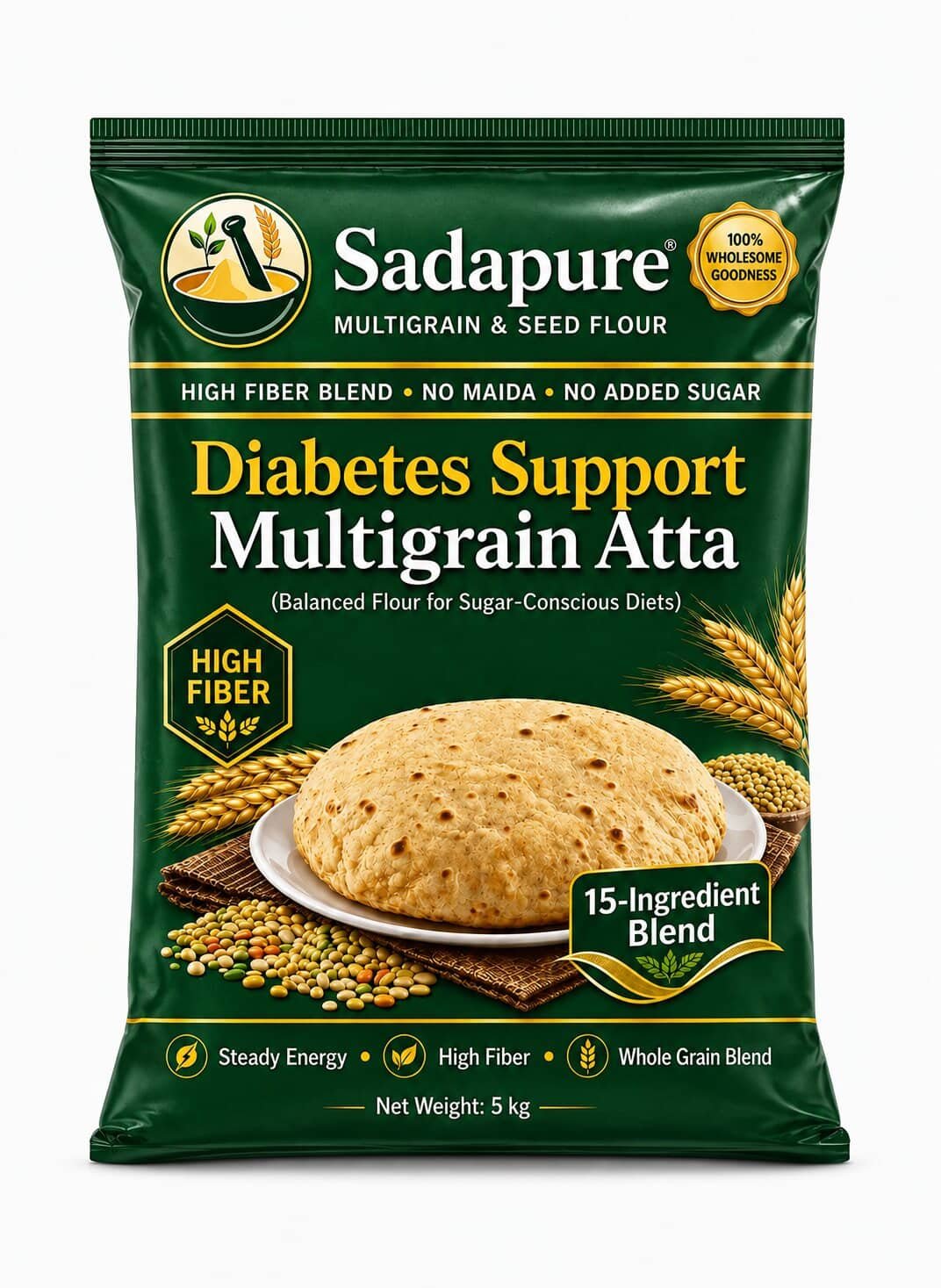
Sadapure Diabetic Multigrain Atta — also sold as Diabetes Multigrain Atta or Sugar Atta — is a stone-ground flour milled from 15 whole grains, pulses and seeds. It is built for Pakistani households that want to cut refined flour out of the daily roti without changing the way they cook. Sixty per cent of the blend is whole wheat, which is what holds a roti together. The other forty per cent is barley, oats, four millets, three pulses, flaxseed, sesame, buckwheat, fenugreek and psyllium husk.
Every percentage is printed on the pack. That matters more than it sounds, because "multigrain" is not a regulated term in Pakistan — a flour can carry the word with ninety-five per cent refined wheat and a pinch of something else, and most brands never publish the split. Ours is below, in full.
This atta is a food product, not a medicine. It is made for sugar-conscious meal planning and portion-controlled eating. It does not treat, prevent or cure diabetes.
سدا پیور ڈائبیٹک ملٹی گرین آٹا 15 اجزاء پر مشتمل ہے — 60 فیصد گندم کے ساتھ جو، جئی، چنا، باجرہ، جوار، راگی، کنگنی، مونگ، سویا، السی، تِل، اسپغول، کُٹو اور میتھی دانہ۔ اس میں نہ میدہ ہے، نہ چینی شامل کی گئی ہے، اور نہ کوئی پریزرویٹو۔ ہر جزو کی فیصد پیکٹ پر لکھی ہے تاکہ آپ خود موازنہ کر سکیں۔ یاد رکھیں: آٹا دوا نہیں ہے۔ روٹی کی مقدار اور باقی کھانا بھی اتنا ہی اہم ہے۔ ذیابیطس کی صورت میں اپنے ڈاکٹر یا ڈائٹیشن سے مشورہ ضرور کریں۔
Wholegrain flour is digested more slowly than refined flour, and the reason is structural rather than nutritional folklore. When wheat is refined into maida, the bran and the germ are stripped away and only the starchy endosperm is left — the starch sits exposed and is broken down into glucose quickly. In a wholegrain flour the bran stays wrapped around the starch, and the fibre, protein and fat that come with it all slow the process down.
A multigrain blend adds a second layer to that. Barley and oats contain beta-glucan, a soluble fibre. Psyllium husk is almost entirely soluble fibre. Chickpea, soy and mung bean bring plant protein and reduce the proportion of the flour that is starch at all. That is why a 15-grain atta behaves differently on the plate from a bag of plain chakki atta.
But there is an honest limit to how far that argument goes, and you deserve to hear it from us rather than discover it on your own glucose meter. Flour is food, not treatment. How much roti you eat, what you eat alongside it, your meal timing and your medication all matter more than which bag you buy. A 15-grain roti eaten in large portions with no protein or vegetables will not serve you better than a plain roti eaten sensibly.
Roman Urdu: sugar ke mareez ke liye atta chunte waqt sirf "sugar free" ka label kaafi nahi. Teen cheezen dekhen — fibre kitna hai, maida shamil hai ya nahi, aur jau, jai ya ispaghol jaise soluble fibre wale ajza mojood hain ya nahi.
Ingredients: Whole Wheat Flour, Barley Flour, Oat Flour, Chickpea Flour, Sorghum Flour, Pearl Millet Flour, Finger Millet Flour, Foxtail Millet Flour, Soy Flour, Mung Bean Flour, Psyllium Husk, Flaxseed Powder, Sesame Seed Powder, Buckwheat Flour, Fenugreek Seed Powder.
No maida. No added sugar. No preservatives. No artificial colours. No artificial flavours.
That single number is the one worth carrying to any other bag on the shelf. When a brand will not tell you how much of its blend is actually not wheat, it is usually because the answer is "not much."
Forty per cent of this blend is barley, oats, millets, pulses and seeds. Sixty per cent is whole wheat. That ratio is also a ceiling, not a target we stopped short of — push the wheat much below sixty per cent and the gluten network gets weak enough that the dough starts tearing when you roll it. Every multigrain atta is a negotiation between nutrition and whether the roti survives the tawa. This is where ours sits, and we would rather tell you that than pretend there is no trade-off.
| Feature | SadaPure Diabetic Atta | Regular Chakki Atta | Maida |
|---|---|---|---|
| Grains, pulses and seeds | 15 | 1 | 1, refined |
| Non-wheat content | 40% | 0% | 0% |
| Bran and germ | Retained | Mostly retained | Removed |
| Soluble fibre sources | Barley, oats, psyllium, flaxseed, fenugreek | Minimal | None |
| Plant protein sources | Wheat, chickpea, soy, mung bean | Wheat only | Wheat only |
| Added sugar | None | None | None |
| Roti texture | Denser, nuttier, darker | Soft, neutral | Very soft, pale |
| Water per kg | 650–700 ml | ~550–600 ml | ~500 ml |
| Dough rest needed | 20–30 min | 10–15 min | Optional |
| Price per kg | Rs.600 | Varies | Varies |
Know the trade-off before you order. A genuine 15-grain roti is denser, nuttier and darker than one made from plain atta. Some households love it immediately; some take a week to adjust. If your family is coming straight off maida, start with a 50/50 blend for the first pack and move across gradually.
We have not published a laboratory-tested glycemic index for this blend, and we will not print one until we have.
Glycemic index is a property of a finished, tested food. As Diabetes Canada sets out in its GI guide, it measures how quickly a specific prepared food raises blood glucose after eating — it cannot be added up from an ingredient list. Milling fineness, cooking method, roti thickness, what you eat alongside it and the total carbohydrate on the plate all change the answer. A flour full of low-GI ingredients can still test higher than expected once it has been ground fine and cooked on a hot tawa.
Plenty of attas in this market carry "Low GI" on the front with nothing behind it. Here is what we actually know, all of it verifiable from the formula above:
When the laboratory report is complete we will publish the tested figure, the testing method and the report itself on this page.
Barley and oats naturally contain beta-glucan, a soluble fibre studied for its effect on blood glucose and cholesterol. Three papers are worth your time:
And here is the part most brands leave out. Those studies use specific doses of beta-glucan in specific preparations. Barley is 9% of this blend and oats are 5%, which works out to well under a gram of beta-glucan in a single roti. The doses used in authorised health claims are considerably higher — Health Canada requires 1 g per serving and 3 g per day for a cholesterol effect.
So we cite this research because it is the reason barley and oats are in the formula at all — not as evidence of what a roti made from it will do. It does not deliver those doses, and we are not going to imply that it does.
The most common complaint about any multigrain atta is a hard roti. Almost every time it is one of three things: not enough water, not enough kneading, or no rest.
If the dough turns sticky, dust lightly with dry flour rather than kneading more flour in — extra dry flour is what makes the finished roti tough. If your roti still comes out hard, it is almost always the rest: try 40 minutes, and use warm water rather than cold.
Also works for: chapati, phulka, paratha, missi roti, thepla, and as a 30% substitution in pancake or besan batters. For a flakier paratha, blend 50/50 with plain atta and go light on the oil.
A good fit if you are: cutting refined flour out of daily meals, watching carbohydrate intake, looking for more fibre and plant protein in everyday diabetic food, cooking one roti for the whole family, or you simply want an atta that prints its full ingredient percentages on the pack.
Please speak to your doctor or dietitian before making this your main flour if you:
Allergens: contains wheat/gluten, soy and sesame. May contain traces of peanuts and tree nuts if processed in a shared facility. Not suitable for anyone with coeliac disease or a wheat, soy or sesame allergy.
If your blood sugar is low, this is not the answer. Hypoglycaemia needs fast-acting carbohydrate as advised by your doctor — not a high-fibre roti.
Medical disclaimer: This is a food product, not a medicine. It is not intended to diagnose, treat, cure or prevent diabetes or any other disease. Results vary with serving size, total diet, physical activity, medication and individual health. Do not stop or change prescribed medication because of a change in diet.
| Pack | Price | Per kg | Approx. rotis |
|---|---|---|---|
| 2.5 kg | Rs.1,500 (was Rs.1,700 — 12% off) | Rs.600 | ~55 |
| 3.5 kg | Rs.2,100 | Rs.600 | ~78 |
| 5 kg | Rs.3,000 | Rs.600 | ~111 |
A flat Rs.600 per kg across every size — no penalty for buying the small pack and no discount for buying the large one. That works out to roughly Rs.27 of flour per roti. Most stores in Pakistan charge more per kilo on the smaller pack; we do not.
Delivery: Rs.250 nationwide, free on orders of Rs.4,000 or more. We deliver across Pakistan including Lahore, Karachi, Islamabad, Rawalpindi, Faisalabad, Multan and Peshawar, plus smaller cities served by our courier partners. Cash on Delivery on every order — no advance payment, you pay the courier when the parcel arrives.
Keep it sealed in an airtight, food-grade container somewhere cool and dry, away from direct sunlight, moisture, heat and strong odours. Always use a clean, dry scoop.
Because this blend contains oil-rich flaxseed and sesame and no preservatives, freshness matters more than it does with plain atta. Use within the period stated on the pack from the milling date printed on the back. In hot or humid weather, keep part of it in the refrigerator and bring it back to room temperature before kneading.
| adaPure Diabetic Multigrain Atta — 15-Ingredient Formula by Weight | |||||
|---|---|---|---|---|---|
| No. | Ingredient | Local Name | % | In 5 kg | What It Brings |
| 1 | Whole Wheat Flour | Gandum (گندم) | 60.0% | 3,000 g | Structure and gluten — this is what makes the roti soft |
| 2 | Barley Flour | Jau (جو) | 9.0% | 450 g | Beta-glucan, a soluble fibre |
| 3 | Oat Flour | Jai (جئی) | 5.0% | 250 g | Beta-glucan, softer crumb |
| 4 | Sorghum Flour | Jowar (جوار) | 4.0% | 200 g | Non-wheat bulk, minerals |
| 5 | Pearl Millet Flour | Bajra (باجرا) | 4.0% | 200 g | Iron and magnesium |
| 6 | Chickpea Flour | Besan / Chana (بیسن / چنا) | 4.0% | 200 g | Plant protein, lowers starch density |
| 7 | Finger Millet Flour | Ragi (راگی) | 3.0% | 150 g | Calcium |
| 8 | Foxtail Millet Flour | Kangni (کنگنی) | 2.0% | 100 g | Slow-digesting starch |
| 9 | Soy Flour | Soya (سویا) | 2.0% | 100 g | Complete plant protein |
| 10 | Mung Bean Flour | Moong (مونگ) | 1.5% | 75 g | Protein, easy digestibility |
| 11 | Flaxseed Powder | Alsi (السی) | 1.5% | 75 g | ALA omega-3, lignans |
| 12 | Psyllium Husk | Ispaghol (اسپغول) | 1.5% | 75 g | Soluble fibre, holds water, adds fullness |
| 13 | Sesame Seed Powder | Til (تل) | 1.0% | 50 g | Calcium, healthy fats |
| 14 | Buckwheat Flour | Kuttu (کٹو) | 1.0% | 50 g | Rutin, minerals |
| 15 | Fenugreek Seed Powder | Methi Dana (میتھی دانہ) | 0.5% | 25 g | Traditional culinary use, faint bitterness |
| Total | 100% | 5,000 g | |||
| Product type | 15-ingredient multigrain flour (atta) |
|---|---|
| Grains, pulses and seeds | 15 |
| Whole wheat content | 60% |
| Non-wheat content | 40% |
| Milling | Stone-ground, coarse, small batch |
| Net weight | 2.5 kg / 3.5 kg / 5 kg |
| Price per kg | Rs.600 (flat across all sizes) |
| Serving size | 40–50 g (1 medium roti) |
| Servings per 2.5 kg pack | ~55 rotis |
| Water per 1 kg flour | 650–700 ml |
| Dough rest time | 20–30 minutes |
| Contains | Wheat/gluten, soy, sesame |
| May contain | Peanuts, tree nuts (shared facility) |
| Gluten-free | No |
| Added sugar | None |
| Preservatives | None |
| Artificial colours / flavours | None |
| Suitable for | Roti, chapati, phulka, paratha, missi roti, thepla |
| Shelf life | [X] weeks from milling date |
| Storage | Airtight, cool, dry, away from sunlight; refrigerate in humid weather |
| Country of origin | Pakistan |
| Batch / milling date | Printed on pack |
There is no single best atta, but dietitians generally point to high-fibre wholegrain blends over refined maida. Check three things on any label: total dietary fibre per 100 g, whether soluble-fibre sources like barley, oats or psyllium are present, and whether sugar has been added. SadaPure Diabetic Multigrain Atta is a 15-grain blend built to those criteria, 60 percent whole wheat with 9 percent barley, 5 percent oats and 1.5 percent psyllium husk, with every percentage printed on the pack. Responses vary between people, so confirm your own plan with your doctor or dietitian.
Wholegrain flour is digested more slowly than refined flour because the bran and germ stay wrapped around the starch, which makes multigrain atta generally a better choice than maida. But multigrain is not a regulated term in Pakistan and many blends are mostly refined wheat with a token sprinkle of something else, so read the percentages rather than the front of the pack. In SadaPure Diabetic Atta, 40 percent of the blend is non-wheat. It still contains carbohydrate and will still raise blood glucose, so portion size and the rest of the meal matter as much as the flour.
Aam tor par woh atta behtar samjha jata hai jis mein maida na ho, fibre zyada ho, aur jau, jai ya ispaghol jaise soluble fibre wale ajza mojood hon. SadaPure Diabetic Atta mein 15 ajza hain, 60 percent gandum ke saath 9 percent jau, 5 percent jai, 4 percent chana, 1.5 percent ispaghol, aur bajra, jowar, ragi, kangni, moong, soya, alsi, til, kuttu aur methi dana. Poori percentage SADAPURE Multigrain Atta k har pack par likhi hai. Lekin atta dawa nahi hai aur roti ki miqdaar ab bhi ahem hai. Apne doctor ya dietitian se mashwara zaroor karein.
Glycemic index is a property of a finished, tested food. Milling fineness, cooking method, roti thickness and the rest of the meal all change it, so it cannot be calculated from an ingredient list. What we can state from the formula is that it contains no refined flour and no added sugar, 40 percent of the blend is non-wheat, it includes four soluble-fibre sources, and it is stone-ground coarse rather than milled fine. When testing is complete we will publish the figure and the report on this page
No flour is truly sugar-free, because the carbohydrate naturally present in grains, pulses and seeds is converted to glucose by your body, and that is true of every atta on the market. Any flour marketed as sugar-free is using the term loosely. What matters is the fibre content, how much refined flour is in the mix, and your portion size.
Our laboratory analysis is in progress and we will publish tested per-100 g figures here when it is complete. The fibre comes from wholegrain bran across six cereals plus chickpea, mung bean, soy, flaxseed and psyllium husk. Protein comes from four sources: whole wheat, chickpea, soy and mung bean. We would rather publish a tested number late than an estimated one now.
Multigrain atta can add grain, pulse, seed and fibre variety, but it still contains carbohydrate and can raise blood glucose. Ingredient proportions, roti size and the rest of the meal all affect the response. This blend should be treated as a food choice, not a glucose-lowering treatment. People with diabetes should monitor portions and follow an individualized plan from their doctor or registered dietitian.
The 14-Grain MultiGrain Atta is our everyday wholegrain flour for general family cooking, and at Rs.500 per kg it is the better-value choice if nobody in your household is watching carbohydrate intake. This blend adds psyllium husk, a higher proportion of barley and oats, and a different pulse ratio, which is why it is Rs.600 per kg.
SadaPure Diabetic Atta is Rs.1,500 for 2.5 kg, Rs.2,100 for 3.5 kg and Rs.3,000 for 5 kg, a flat Rs.600 per kg across all sizes with no penalty for buying the smaller pack. That is roughly Rs.27 of flour per roti. Delivery is Rs.250 and free on orders of Rs.4,000 or more, with cash on delivery available nationwide.
At roughly 40 to 50 g of flour per medium roti, the 2.5 kg pack makes about 55 rotis, the 3.5 kg about 78 and the 5 kg about 111. For a family of four eating two rotis each at dinner, the 5 kg pack lasts around two weeks.
Nine times out of ten it is the rest. Multigrain flour needs 20 to 30 minutes covered before rolling so the fibres fully hydrate. Try 40 minutes and use warm water rather than cold. The other two causes are too little water, since this blend needs 650 to 700 ml per kg, and too much dry flour dusted on during rolling, which toughens the finished roti.
Roti, chapati, phulka, paratha, missi roti and thepla all work, and it substitutes well at around 30 percent in pancake or besan batters. For a flakier paratha, blend it 50/50 with plain atta. We would not recommend it for puri or deep-fried preparations, because deep-frying undoes the point of choosing this flour.
The texture and aroma were consistent across the pack, and the preparation guidance was helpful.
24 Feb 2025We wanted a grain blend with transparent labelling. This one has a balanced taste and works in our normal roti routine.
16 Feb 2025The flour mixed well, did not become sticky, and made soft chapatis when the dough was rested properly.
11 Feb 2025I appreciated the straightforward ingredient list and portion guidance. The rotis were easy to roll and tasted good with daal.
3 Feb 2025