
Quick answer: The simplest way to improve a man's daily energy through food is to swap refined white flour for whole, traditional grains and seeds. Barley (jau), sorghum (jowar), oats (jai) and chickpea (chana) digest slowly, so energy arrives in a steady stream instead of a spike and a crash. Pumpkin, sesame and chia seeds add zinc and magnesium on top. No single food works like a stamina pill, but a better daily roti, eaten with enough water and a little healthy fat, is one of the easiest changes you can make this week.
Introduction: The Silent Energy Drain in Modern Men
Many men wake up tired, run on tea until lunch, and feel their eyes get heavy around three in the afternoon. They put it down to work pressure and carry on. Yet a large part of that pattern starts on the plate, and the plate is easy to change.
In most Pakistani homes, the daily staples are a paratha with chai in the morning, a roti with salan at lunch, and snacks such as biscuits, samosas, or namkeen in the evening. Almost every item is made from finely milled flour and refined sugar. This guide explains why that combination drains energy, why traditional grains and seeds work better, and how to use them in simple meals without a complicated plan.
Why Afternoon Slumps and Chronic Fatigue Are Not "Just Age"
It is easy to blame a 4 pm slump on getting older, but men in their twenties and thirties report it too. Age rarely explains it on its own. These are the more common causes:
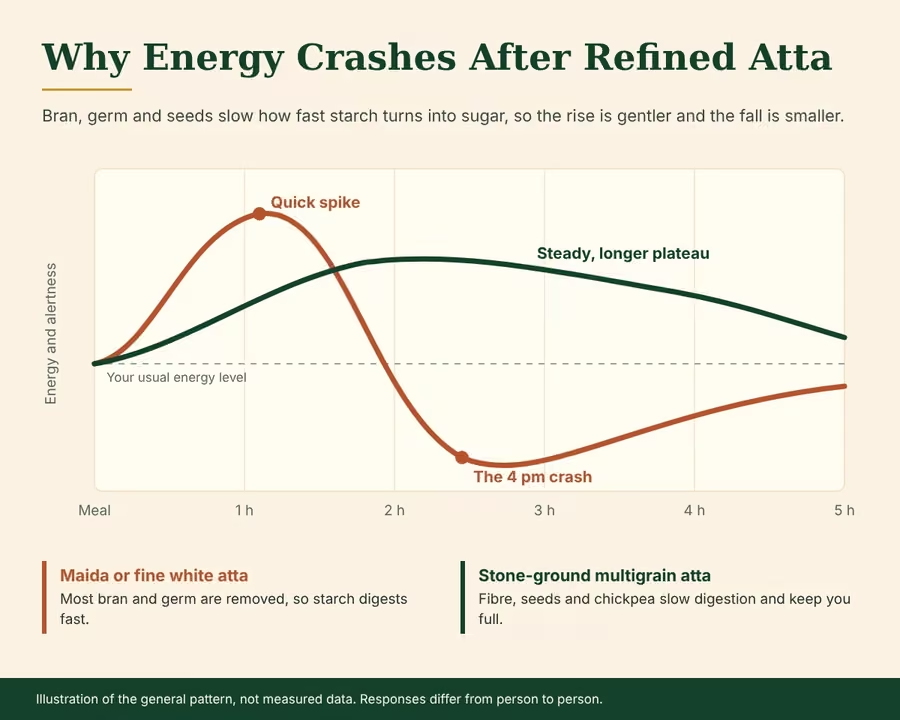
- A fast-digesting breakfast. Maida paratha with sweet tea raises blood sugar quickly, then causes it to drop. The fall is what you feel as weakness, hunger, and poor focus.
- Too little fluid. Even mild dehydration can make you feel sluggish, and many men drink very little plain water between meals.
- Short or broken sleep. Late nights followed by early starts leave the body with little time to recover, no matter what you eat.
- Low intake of key nutrients. Diets heavy in refined flour are low in magnesium, zinc, and B vitamins. Low magnesium levels, for example, are linked to tiredness and weakness, although true deficiency is uncommon in healthy people.
- Medical causes. Anemia, thyroid problems, vitamin D or B12 deficiency, and diabetes can all cause constant tiredness.
Food changes help with the first, second, third, and fourth points. If you stay exhausted despite sleeping well and eating better for several weeks, get a basic blood test. Fatigue that does not lift deserves a proper check, not another cup of tea.
The White Flour (Maida & Refined Chakki) Trap: Blood Sugar Spikes & Crashes
A wheat grain has three parts. The bran is the fiber-rich outer coat. The germ is the small core packed with healthy fats and vitamins E and B. The endosperm is the starchy middle. Milling for white flour removes the bran and germ, leaving mostly the endosperm. According to the Harvard T.H. Chan School of Public Health, refining wheat removes over half of its B vitamins, about 90% of its vitamin E, and nearly all of its fiber
What remains is starch that the body breaks down quickly. Blood sugar climbs fast, insulin answers, and soon afterward you feel hungry and low again. Harvard notes that bran and fiber slow this breakdown, which is why whole grains keep blood sugar more steady than refined grains.
Maida is the obvious culprit, but it is not the only one. Some fine-packaged atta and "chakki" flour are sifted to remove the bran, because sifted flour makes whiter, softer rotis. It looks like atta but behaves closer to refined flour. When you shop, look for expressions like whole wheat (sabut gandum) and check whether the bran is still in the flour.
The Ancient Solution: Why Traditional Desi Grains Fuel Long-Lasting Stamina
Before roller mills, South Asian households ground their own flour from whatever grew nearby: wheat, barley, jowar, bajra, ragi, and chana. Rotis were often made from a blend, and nothing was sifted away. Those grains share the features that modern nutrition now recommends: more fiber, more minerals, and slower digestion.
The idea is not nostalgia. It is a practical bet that a roti made from several whole grains and a small number of seeds gives you more to work with than one made from a single, finely milled flour. The sections below show what each grain and seed contributes, and where the claims stop.
The Science of Grain-Based Energy: Complex Carbs vs. Empty Calories
Carbohydrates are the body's main fuel, so cutting them out is not the answer. The better question is which carbohydrate you choose. "Complex" carbohydrates come packaged with fiber, protein, and minerals. "Empty" ones, such as sugar and white flour, bring calories but little else.
Sustained Glycogen Stores: Slow-Burning Energy That Lasts the Workday
After a meal, your body keeps some carbohydrate in the liver and muscles as glycogen, a reserve it draws on between meals and during exercise. A fast-digesting meal quickly raises blood sugar, and the surplus is soon used or stored. A slow-digesting meal releases sugar gradually, so the reserve is topped up over hours instead of minutes.
This matters most for men who work long shifts, travel by motorbike, or train a few evenings a week. A multigrain roti with dal providesdal provides a longer runway than a plate of white rice or a maida paratha, which is why people often say they feel "full for longer" afterward.
Gut Health and Nutrient Digestion: The Role of Soluble & Insoluble Fiber
Whole grains contain two kinds of fiber, and each serves a different role.
- Soluble fiber dissolves in water and forms a gel. Barley and oats are rich in a soluble fiber called beta-glucan, which slows sugar absorption and helps lower LDL cholesterol.
- Insoluble fiber is the rough bran part. It does not dissolve, but it adds bulk and keeps stools soft, which helps prevent constipation and diverticular disease.
There is one trade-off worth knowing. Grains, seeds, and beans contain phytates, natural compounds that bind zinc in the gut and reduce how much you absorb. The US National Institutes of Health notes that zinc absorption from food ranges from about 5% to over 50%, depending on the amount of phytates in the diet. This is no reason to avoid whole grains. It is a reason to eat a varied diet, include protein-rich foods, and not rely on one single source for any mineral.
Micronutrients That Matter: Zinc, Magnesium, and B-Vitamins for Men's Vitality
Three nutrient groups come up again and again in men's diets:
- Zinc promotes immune function, protein and DNA synthesis, and wound healing. Men aged 19 and over need 11 mg a day. Whole wheat bread provides about 0.6 mg per slice, compared with 0.2 mg in white bread, so switching to whole grain triples the amount.
- Magnesium supports over 300 enzyme systems, including those that release energy from food and enable muscles and nerves to function. Men need about 400-420 mg per day.
- B vitamins sit mainly in the bran and germ, which is exactly what refining throws away. They help the body turn food into usable energy.
Food-first thinking suits all three. A roti that retains the bran, germ, and seeds provides small, steady amounts of each, which add up over the course of a day.
Top Traditional Grains for Male Stamina & Vitality
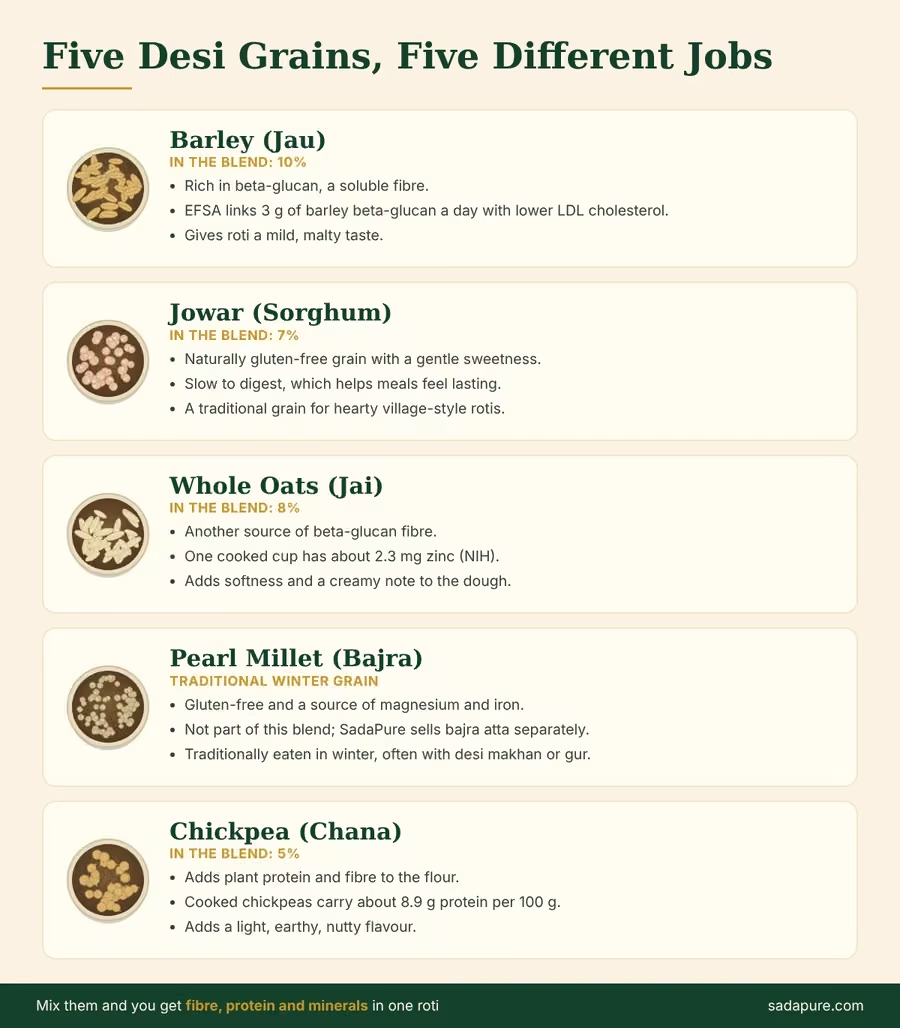
Five desi grains stand out for everyday cooking. Each has its own strengths, and together they cover more ground than any one grain alone.
Barley (Jau): Cooling Beta-Glucan Powerhouse for Heart & Endurance
Barley is among the richest everyday sources of beta-glucan. The European Food Safety Authority has concluded that consuming at least 3 g of barley beta-glucan per day lowers LDL cholesterol, the type linked to heart disease. In traditional desi food culture, barley is also known as a "cooling" grain, often taken as jau ka pani or sattu in summer. That is a cultural description rather than a laboratory finding.
Be realistic about quantity. In SadaPure's blend, barley makes up 10% of the flour, so a few rotis provide only part of that 3 g target. Think of barley as one useful piece of a high-fiber diet, not a cholesterol treatment. If you want more, you can add pure barley flour (jau ka atta) to your regular dough. Barley contains gluten.
Sorghum (Jowar): Naturally Gluten-Free Grain for Post-Workout Carbs
Jowar is naturally gluten-free and has a gentle, slightly sweet taste. It digests slowly, which suits a meal eaten after training, when muscles need carbohydrates to replenish glycogen. Because jowar is gluten-free, its dough does not stretch like wheat dough, so it works best when mixed with wheat flour. This is exactly how it is used in a multigrain blend. A jowar-only roti is a skill in itself.
A note for people avoiding gluten: jowar itself is safe, but a blend that also contains wheat, barley, and oats is not. Check the label of any mixed flour.
Whole Oats (Jai): Slow Carbohydrates for Calm, Steady Energy
Oats also provide beta-glucan and a good amount of zinc, about 2.3 mg per cooked cup, according to the NIH. They are digested slowly, so they are a good choice at breakfast when the day ahead is long. In flour form, oats add softness and a mild, creamy flavor to rotis, helping balance the stronger taste of barley and seeds.
You will see claims that oats "calm the nerves". There is no solid proof for that. What oats do reliably is provide steady carbohydrate and fiber, and that alone makes the day feel less jumpy.
Pearl Millet (Bajra): Ancient Mineral Reserve for Winter Warmth & Power
Bajra is a gluten-free millet traditionally eaten in the cold months, often with desi makhan or gur. Millets are a source of magnesium, iron, and phosphorus. Cooked millet gives roughly 6 g of protein and 2 g of fiber per cup, and about 18% of the daily magnesium value. Like other whole grains, millets contain phytates and polyphenols that can limit the absorption of iron and zinc consumed in the same meal. Soaking, fermenting, or sprouting reduces this effect.
Bajra is not part of the Stamina Booster blend. If you enjoy it, you can buy bajra atta (millet flour) separately and make a winter roti on cold mornings.
Chickpea (Chana): The Lean Plant Protein Pillar
Chana is the odd one out in the grain family, because it is a legume. That makes it useful: cooked chickpeas provide about 8.9 g of protein and 7.6 g of fiber per 100 g, so they boost both the protein and fiber content of a roti. The small, dark desi chickpea, kala chana, is nutritionally similar to the lighter kind and is a classic stamina food when soaked and boiled or roasted. The SadaPure blend uses5% chickpea (chana) flour.
For a snack, roasted chana is an excellent swap for fried namkeen. It is crunchy and filling, with no added sugar.
The Super-Seed Advantage: What Grains Alone Cannot Provide
Seeds are small, but they pack in minerals and healthy fats that grains lack. They are also easy to add, because they can be ground into flour. The key is to understand what each seed truly offers, because much of the marketing around seeds goes beyond the evidence.
Pumpkin Seeds (Kaddu Ke Beej): A Rich Plant Source of Zinc and Magnesium
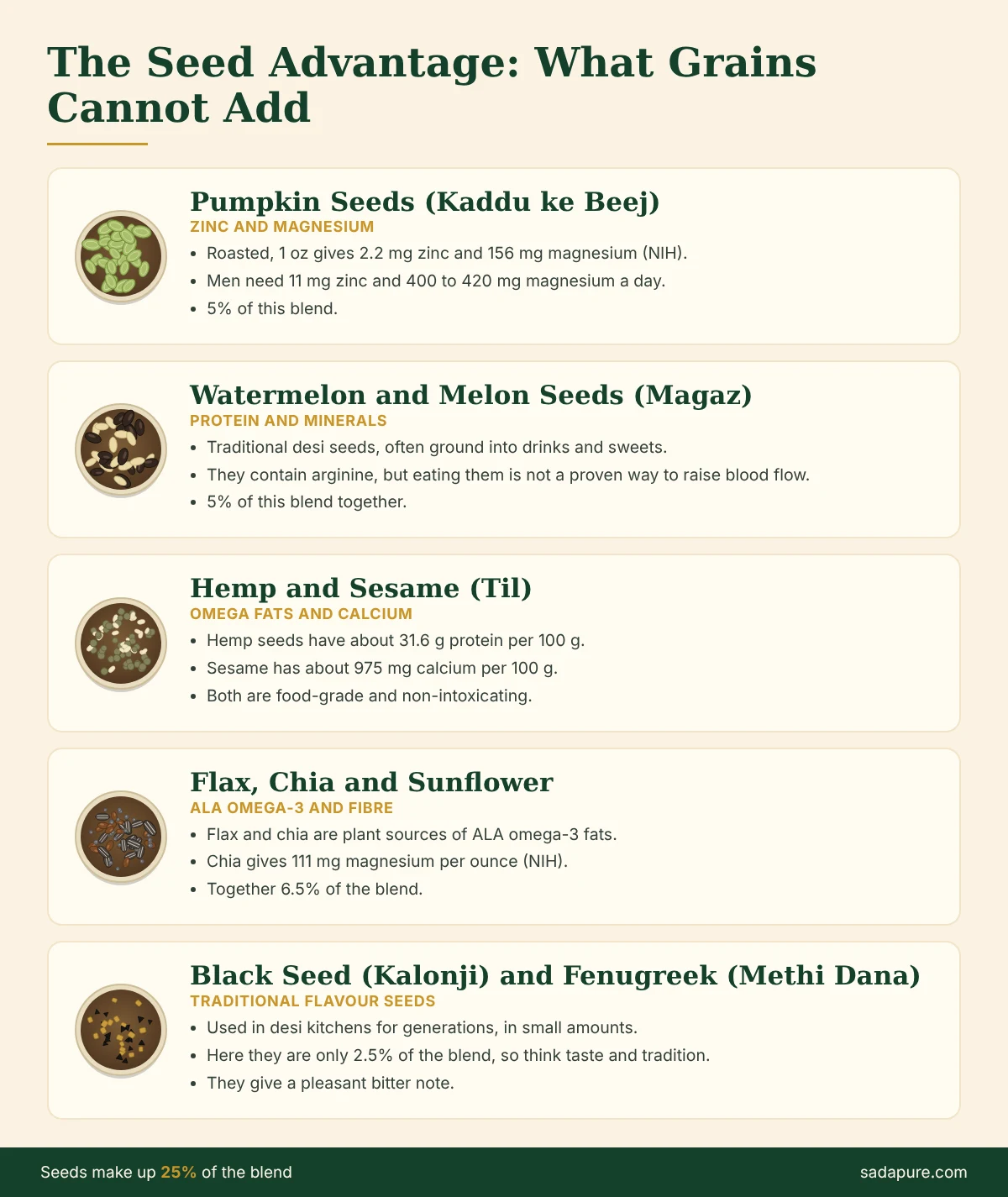
Pumpkin seeds are among the best plant sources of both minerals. One ounce (about 28 g) of roasted seeds provides 2.2 mg of zinc, roughly a fifth of a man's daily need, and 156 mg of magnesium, over a third of the daily target.
Zinc is needed for the body to make testosterone normally, and low zinc can lower it. But the link works in one direction. Evidence suggests that correcting a deficiency helps, while extra zinc in men who already get enough does little. Seeds in flour are also eaten in small amounts: three rotis of this blend carry only about 6 g of pumpkin seed. That is a modest, useful contribution alongside the rest of your food, not a replacement for a varied diet.
Watermelon & Melon Seeds (Char Magaz): L-Arginine and Circulation, Explained Honestly
Magaz seeds are a traditional desi ingredient, usually ground into thandai, sweets, and gravies. They contain protein, healthy fats,s and an amino acid called arginine, which the body uses to make nitric oxide, a molecule that helps blood vessels relax.
That chain of facts is real, but it is often extended to include claims about blood flow and male performance. A small study found that drinking large amounts of watermelon juice increased blood arginine levels, but no effects on circulation or sexual function were measured. In short, these seeds are a tasty source of nutrients, and the evidence does not support calling them a treatment for circulation.
Hemp & Sesame (Til): Plant Omega Fats, Calcium and Bone Support
Hemp seeds are unusually rich in protein, about 31.6 g per 100 g, and provide omega-3 and omega-6 fatty acids. They are food-grade and non-intoxicating, so they do not contain the plant's psychoactive compounds. Sesame seeds add calcium and iron: per 100 g, whole dried sesame has roughly 975 mg of calcium, 351 mg of magnesium, 7.75 mg of zinc, and 14.6 mg of iron.
These numbers are for a full 100 g, far more than you would eat in a day. Individually, the amounts are small, but they add up over the week. Sesame is also a common allergen, which is why it is declared on the pack.
Black Seed (Kalonji) & Fenugreek (Methi Dana): Traditional Flavor Seeds With Modest Evidence
Both seeds have a long place in desi kitchens and home remedies. Their research story is more modest than their reputation. A 2026 systematic review of 13 trials of fenugreek supplements in men found only a very small gain in total testosterone, no stable change in free testosterone, and rated the certainty of the evidence "very low". The authors concluded that it does not support testosterone-boosting claims. The trials also used concentrated extracts at 500 to 600 mg/ay, which is not the same as the seeds in flour.
In SadaPure's blend, fenugreek is 1.5%, and kalonji is 1%, so three rotis contain roughly 2 g of fenugreek seed and 1 g of kalonji. At that level, they add flavor and a traditional touch, with a pleasant bitter note that offsets the sweetness of oats and sorghum.
5 Realistic Diet Changes Every Man Can Make This Week
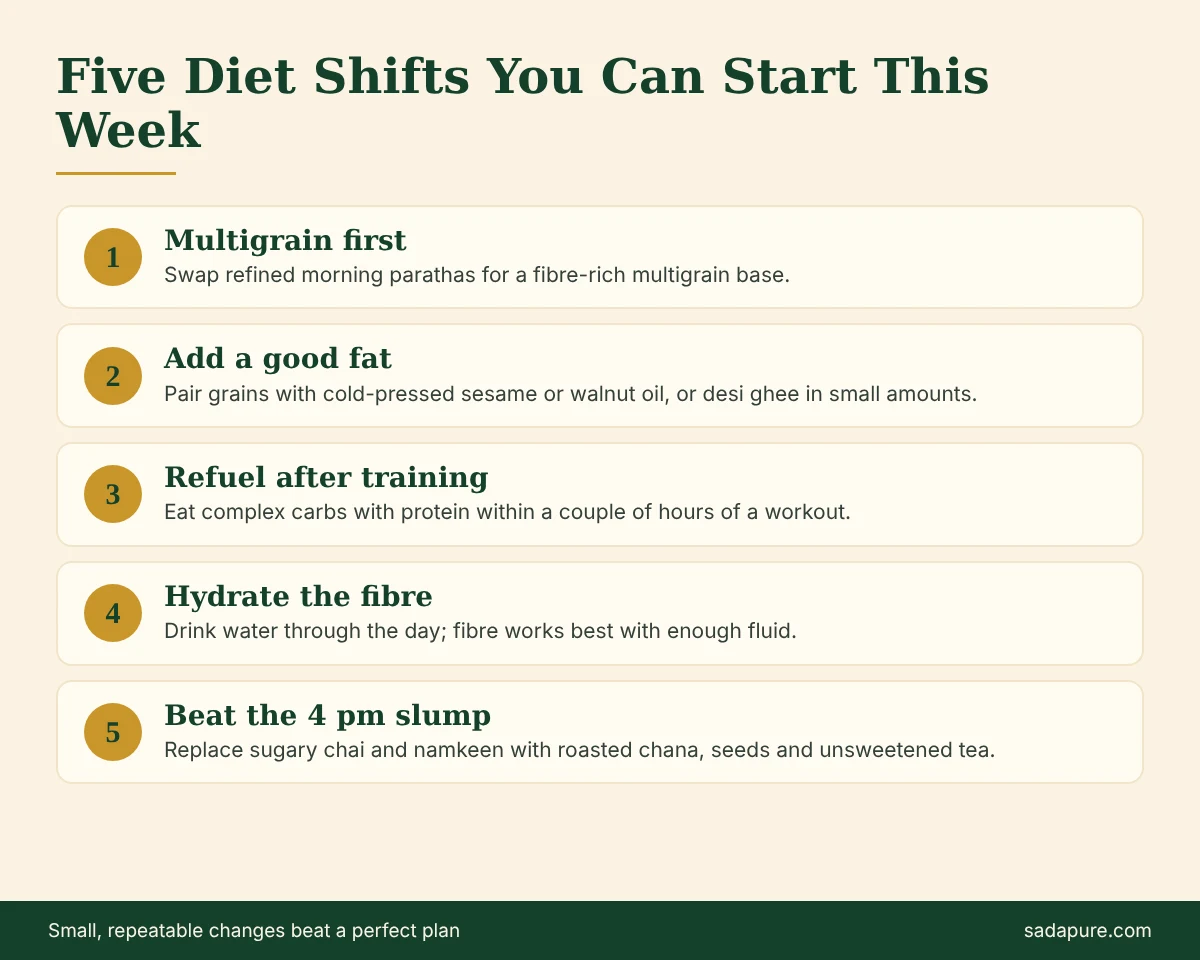
You do not need to overhaul your kitchen. Start with one change, then add another once it feels normal.
Shift #1: Swap Refined Morning Parathas for a High-Fiber Multigrain Foundation
Breakfast sets the mood for the whole day, so start there. Make your usual paratha or phulka from a multigrain atta instead of maida or fine white flour. Keep the rest the same: a spoon of dahi, an egg, or a little desi makhan. You will taste the difference, but most families adapt within a week.
If the family resists, mix half multigrain flour with half of your regular atta for the first week, then raise the share. A gradual change is easier on both taste and digestion.
Shift #2: Combine Grains with Healthy Fats (Cold-Pressed Sesame or Walnut Oil)
Fat slows digestion further and helps the body absorb fat-soluble vitamins, such as vitamin E, which is also found in the grain germ. A small amount is enough: a teaspoon of ghee or desi makhan on the roti, or a few drops of cold-pressed sesame or walnut oil drizzled on a salad or cooked dish.
Use only oils labeled as food-grade for eating. Cosmetic oils sold for hair and skin are not made for cooking, even if they are pure.
Shift #3: Upgrade Your Post-Workout Recovery with Complex Grain Carbs
After a gym session or a long physical shift, muscles need carbohydrates to restore glycogen stores and protein to repair muscle fibers. A multigrain roti with dal, chicken, eggs, or dahi covers it all on one plate. Aim to eat within an hour or two of finishing, so recovery is not left waiting until a late dinner.
This is a better option than a sugary drink and a samosa, which provide quick carbohydrates but little protein or fiber.
Shift #4: Hydrate the Fiber — The Golden Water Rule for Whole-Grain Digestion
Fiber works by holding water. When you increase fiber intake without increasing fluid intake, the result can be gas, a heavy stomach, or constipation, and people wrongly blame the grain. The fix is simple: drink water steadily through the day, with a glass alongside each meal, and add fiber gradually over a couple of weeks.
A practical check is urine color. Pale yellow usually means you are drinking enough, while dark yellow signals you should drink more.
Shift #5: Say Goodbye to 4 PM Sugary Chai and Namkeen Snacks
The late-afternoon cup of sweet chai with namkeen is the habit that locks in the slump. Both are fast-digesting, and namkeen adds a lot of fried fat. Replace them with something that has staying power:
- A handful of roasted chana, which adds protein and fiber
- A small bowl of mixed seeds, such as pumpkin and sunflower, for minerals.
- A fruit with a few almonds, if almonds suit you.
- Tea with less sugar, or none, drunk after the snack rather than instead of it.
You do not have to give up chai. Cutting the sugar and adding a real snack is enough to flatten the 4 pm dip.
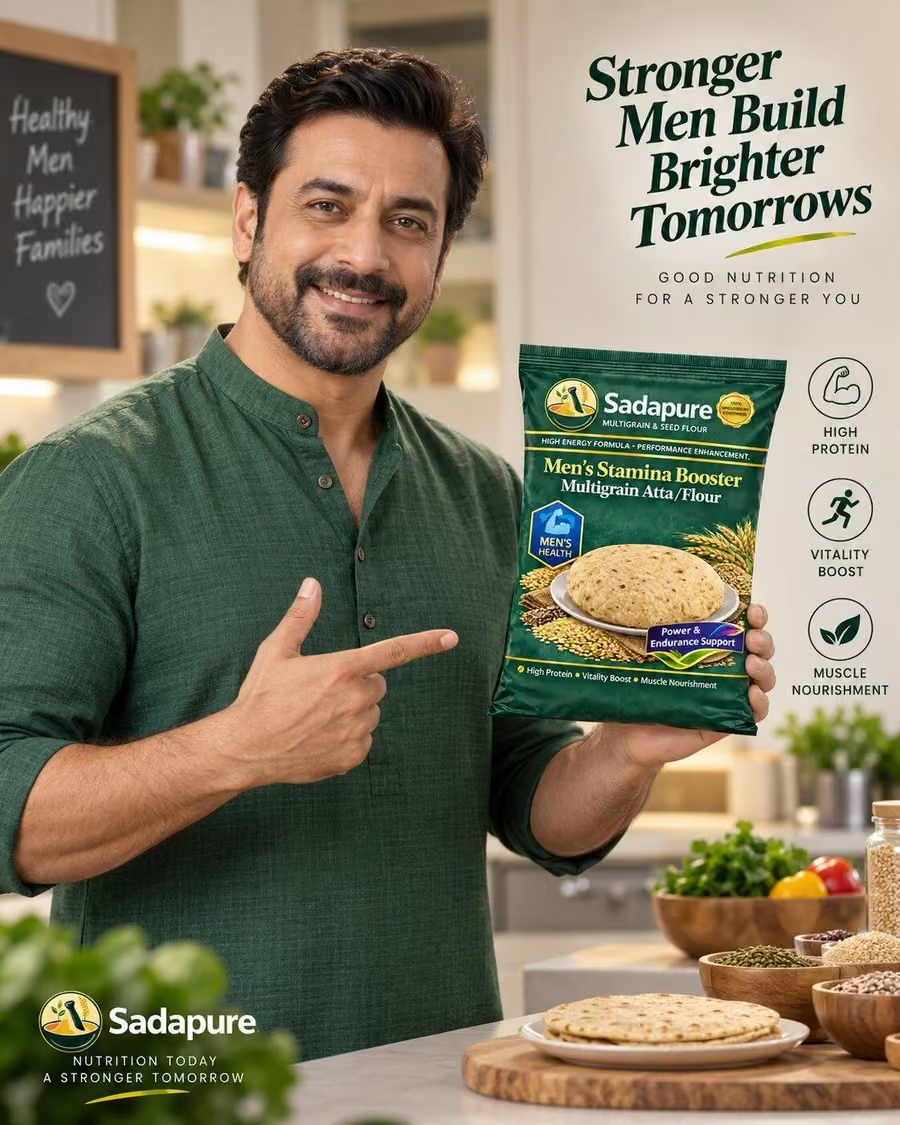 | SadaPure Pick for Men Men's Stamina Booster Multigrain Atta A 15-ingredient stone-ground blend of 45% whole wheat with barley, oats, sorghum, chickpea and ten seeds. Medium-coarse, nutty and made for daily rotis, parathas and thepla. ✓ Full formula with weights, no hidden fillers From PKR 3,250 for 2.5 kg · PKR 4,550 for 3.5 kg |
Spotlight: SadaPure Men's Stamina Booster Multigrain Atta (15-Grain Stone-Ground Blend)
If you would rather not buy and mix a dozen ingredients yourself, SadaPure Men's Stamina Booster Multigrain Atta combines the grains and seeds from this guide into a single flour. It is designed for daily rotis, parathas, and thepla.
Why 100% Transparency Matters: The Exact 15-Ingredient Formula (No Secret Fillers)
Many "multigrain" flours do not say what is inside. SadaPure publishes the full formula with weights for a 5 kg batch, and the percentages add up to exactly 100%, leaving no room for a hidden filler.
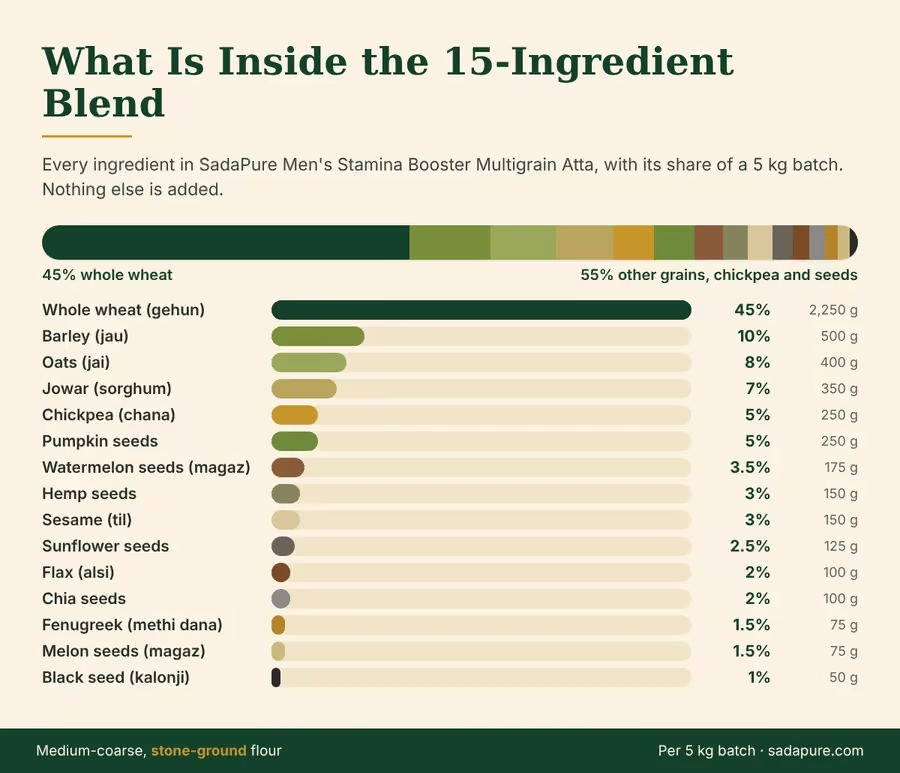
In plain words, the flour is based on whole wheat, barley, oats, sorghum, and chickpeas, with pumpkin, watermelon, hemp, sesame, sunflower, flax, chia, and melon seeds, and fenugreek and black seed for flavor.
45% Whole Wheat + 55% Functional Grains & Seeds: Taste Matches Performance
The balance is deliberate. Wheat is 45% because its gluten provides the dough with strength and stretch, which helps prevent rotis from cracking. The remaining 55% brings fiber, protein, and minerals. Of that share, 30% is other grains and chickpeas, and 25% is seeds.
The product description sets out how the mix behaves. The texture is medium-coarse with visible flecks of cracked seeds. The aroma is earthy and nutty. The flavor is robust, balancing the sweetness of sorghum and watermelon seeds against the pleasant bitterness of fenugreek and black seed. Chia and flax help hold moisture, so the dough does not dry out quickly.
Stone-Ground (Chakki) Milling: Keeping the Germ and Bran
Stone grinding is a slower, cooler way of milling than high-speed roller mills, and whole-grain flour made this way keeps the bran and germ in the bag. That is what carries the fiber, vitamin E, and B vitamins described earlier. It also explains the flour's coarser, speckled look: you are seeing the actual grain and seed pieces, not a bleached, uniform powder.
How It Compares to Regular Store Chakki Atta
| Feature | SadaPure Stamina Booster Atta | Regular wheat chakki atta |
|---|---|---|
| Grains used | Wheat, barley, oats, sorghum and chickpea | Usually wheat only |
| Seeds | 10 seeds, including pumpkin, hemp, sesame, flax and chia | None |
| Whole wheat share | 45%, shown on the label | Often not stated; some brands sift out bran |
| Fibre sources | Wheat bran, barley and oat beta-glucan, seed fiber | Wheat bran only, if it is kept |
| Formula disclosure | All 15 ingredients with weights | Usually a single ingredient line |
| Texture | Medium-coarse with seed flecks | Fine and uniform |
| Taste | Nutty, earthy, slightly sweet with a mild bitter note | Plain wheat flavor |
| Dough | Dense; needs a rest so the fiber can absorb water | Soft and quick to roll |
Plain atta is cheaper and easier to roll, and it still makes a decent roti when it's genuinely whole wheat. The Stamina Booster blend is for people who want more variety, fiber, and seeds from the same daily flour.
| Pack | Price (PKR) | Delivery |
|---|---|---|
| 2.5 kg | 3,250 | Cash on Delivery across Pakistan |
| 3.5 kg | 4,550 | Free delivery, as it is above PKR 4,000 |
Both sizes work out to PKR 1,300 per kg, inclusive of taxes. Customers rate the flour 4.7 out of 5 across 3 reviews on the product page. See the full product page to choose your pack.
How to Knead, Cook, and Enjoy Men's Multigrain Roti
A high-fiber flour behaves differently from plain atta, and that is often why a first try turns out stiff. A few small habits fix it.
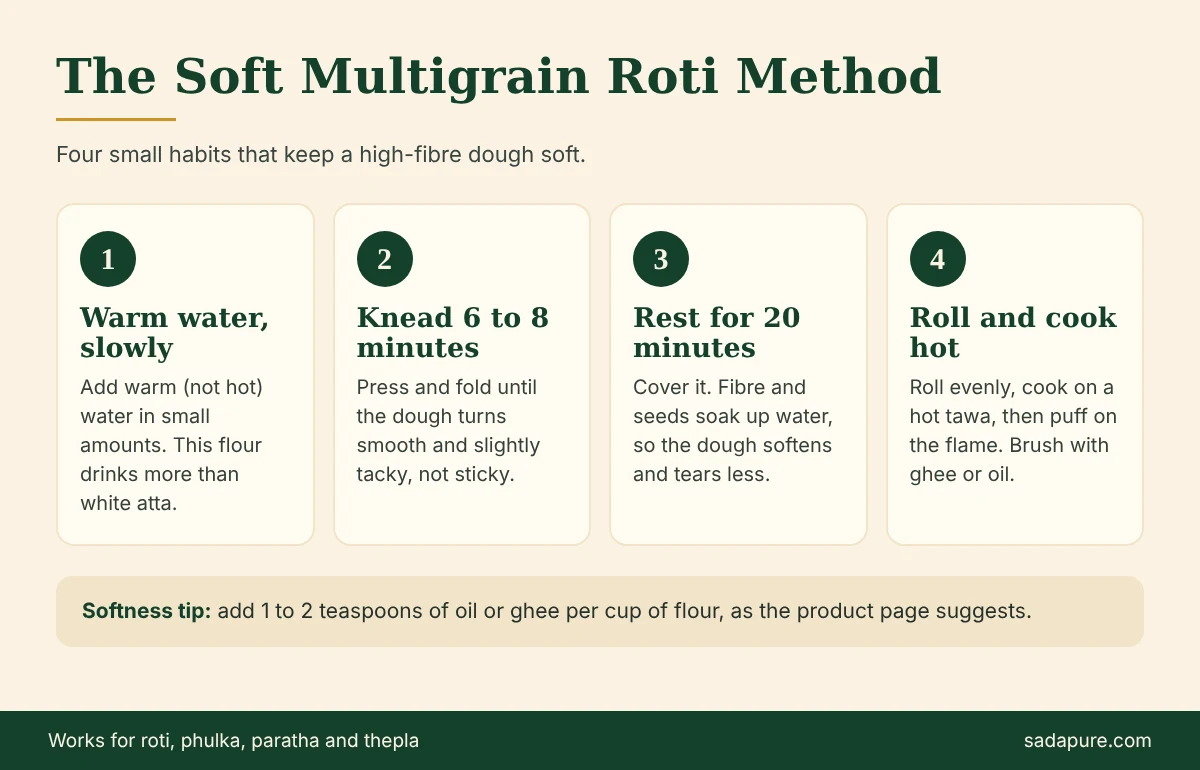
The Warm Water & 20-Minute Dough Rest Method (For Soft, Tearable Rotis)
Start with warm, not hot, water and add it in small amounts. The fiber and seeds absorb more water than white flour, so a dough that feels right at the start often turns out dry later. Knead for 6 to 8 minutes, until smooth and slightly tacky.
Then rest the dough, covered, for about 20 minutes. During this time, the bran, chia, and flax soak in warm water and soften, and the gluten relaxes. The result is a dough that rolls out evenly and tears less. For extra softness, add one to two teaspoons of oil or ghee per cup of flour, as suggested on the product page.
Recipe Idea: SadaPure High-Energy Breakfast Phulka with Desi Makhan
This simple breakfast is filling, takes under 30 minutes to make, and is perfect for a busy morning.
Ingredients (makes 6 phulkas):
- 2 cups (about 250 g) SadaPure Men's Stamina Booster Multigrain Atta, plus extra for dusting
- Three-quarters of a cup of warm water, added gradually
- Half a teaspoon of salt
- 2 teaspoons of oil or ghee for the dough
- Desi makhan, plus dahi or boiled eggs to serve
Method:
- Mix the flour and salt, add the oil, then pour in the water in small amounts while mixing.
- Knead for 6 to 8 minutes, then cover and rest for 20 minutes.
- Divide into six balls, dust lightly, and roll each into a thin, even disc.
- Cook on a hot tawa for about 20 seconds, flip, cook the other side, then move it onto the open flame, where it puffs.
- Rub a little desi makhan on top and serve hot with dahi or eggs.
If you like, finish with a few drops of a food-grade, cold-pressed oil instead of makhan. Check the label before using any oil in food.
Recipe Idea: Savory Stamina Thepla with Methi and Jeera
Thepla keeps well, making it a good tiffin item, a travel snack, or an easy lunch. The flour already contains fenugreek seed, so use fresh leaves here for freshness, not more seed, which would turn the dough bitter.
Ingredients (makes about 8 thepla):
- 2 cups (about 250 g) SadaPure Men's Stamina Booster Multigrain Atta
- Half a cup of finely chopped fresh methi leaves
- Half a cup of thick dahi
- Half a teaspoon of jeera (cumin seeds), half a teaspoon of red chili powder, a quarter teaspoon of haldi, and salt to taste
- 1 tablespoon of oil, plus a little for cooking
Method:
- Combine the flour, methi, spices, salt, and oil. Add the dahi and mix well.
- Add a splash of warm water only if needed, and knead to a firm, soft dough. Rest for 20 minutes.
- Roll thin rounds and cook on a medium tawa, applying a little oil on both sides until golden spots appear.
- Serve with dahi, pickle,e or a glass of lassi.
Realistic Expectations & Long-Term Vitality: What to Expect in 30 Days
Food does not change your body overnight, and no atta is a cure. A better daily diet can make your days feel more even. The timeline below describes what many people notice, but everybody responds differently, and diet, sleep, training, and health all play a part.
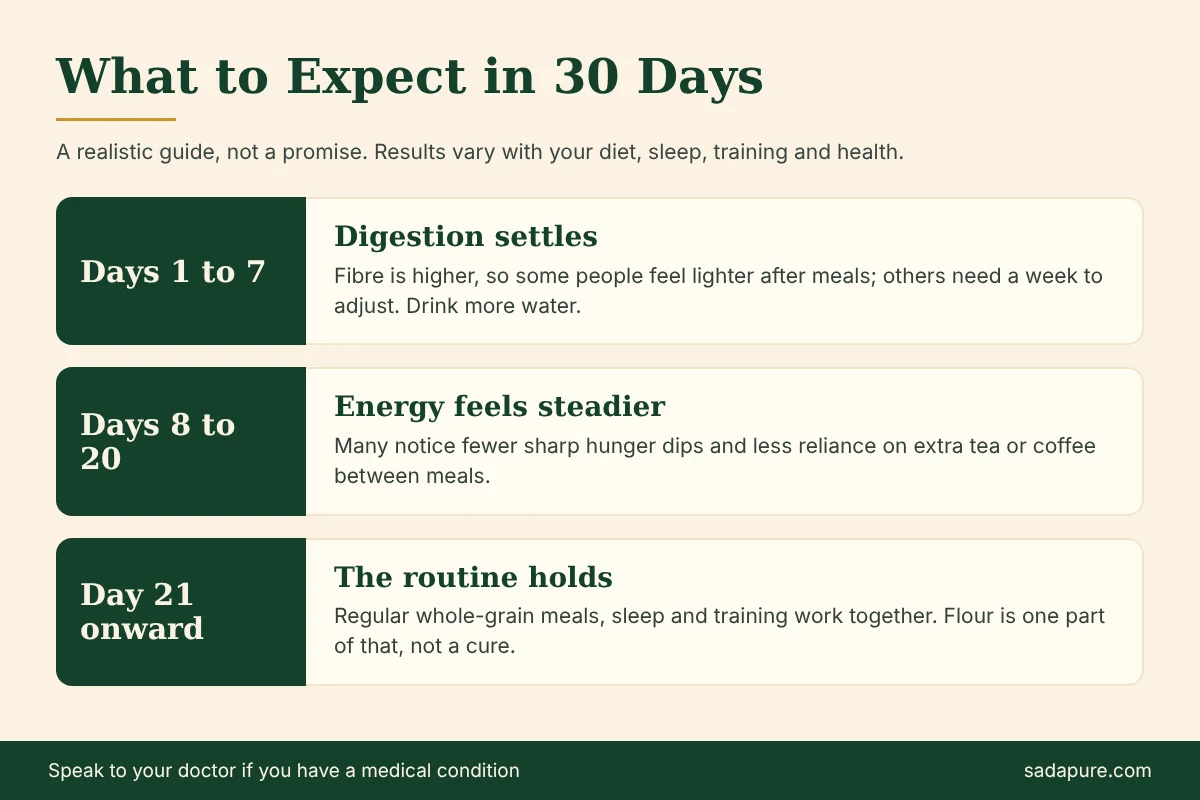
Days 1–7: Improved Digestion, a Lighter Stomach, No Heavy Food Coma
In the first week, the main change is in how meals sit. Refined flour tends to leave a heavy, sleepy feeling after lunch. Fiber-rich rotis often feel lighter once your gut gets used to them. Some people also feel fuller sooner and eat less. If you feel gassy or bloated, you may be increasing your fiber intake too quickly. Drink more water, reduce the number of rotis for a few days, or mix multigrain flour with your usual atta.
Days 8–20: Steady Daily Energy, Fewer Caffeine Cravings, Better Workout Output
By the second and third weeks, many men notice fewer sharp dips in hunger between meals and less urge to reach for an extra cup of tea or coffee. Slower-digesting carbohydrates keep blood sugar more stable, which tends to smooth out mood and focus. Workout sessions can feel better when the pre-workout meal is a proper roti and dal rather than a quick sugary snack, although workout quality also depends on sleep and programming.
Days 21+: Sustained Stamina, Better Sleep Quality, and Core Vitality
After three weeks, the new pattern is a habit. Your meals are steadier, your afternoons less erratic, and it is easier to maintain other good habits, such as walking, regular sleep, and adequate protein intake. Better sleep often follows a lighter evening meal and a calmer blood sugar pattern, but sleep depends on many factors, including screen use, stress, and caffeine timing.
Keep the bigger picture in view. If you still feel unusually tired, lose weight without trying, feel very thirsty, or have a medical condition, see a doctor. Food supports good health. It does not replace a check-up.
Frequently Asked Questions (FAQs)
Will multigrain roti make me feel heavy or bloated?
It can for the first few days, because the fiber content is much higher than in white atta. Your gut needs time to adjust. Start with one or two rotis a day, drink water throughout the day, and rest the dough properly so it is soft and easier to digest. Barley, oats, and chickpeas contain carbohydrates that can cause gas in some people. If discomfort lasts beyond a couple of weeks, reduce the portion or mix the flour with your usual atta.
How does zinc from pumpkin seeds support male energy?
Zinc is a cofactor for hundreds of enzymes and promotes immune function, protein synthesis, and DNA synthesis. Low zinc can lower testosterone, and correcting a shortfall can help. Pumpkin seeds provide about 2.2 mg per ounce, against a daily need of 11 mg for men. In a multigrain roti, the seed share is small, so it functions as one contribution among many foods rather than a booster on its own.
Can diabetic men or seniors use SadaPure Men's Stamina Atta?
The whole grains, seeds, and chickpeas give this flour more fiber than plain white atta, and fiber slows the rate at which sugar enters the bloodstream. Still, it is a carbohydrate food, and portion size matters. Men with diabetes should confirm their portion sizes with a doctor or dietitian and may prefer SadaPure's dedicated diabetes multigrain flour. Seniors can use the flour as long as it suits their diet and chewing comfort, and anyone with kidney disease or a prescribed diet should ask their doctor first.
How many rotis per day are recommended for active men?
There is no fixed number because it depends on body size, activity level, and the rest of the meal. A common pattern is two to three medium rotis at lunch and at dinner. Active men who train often may need more, and desk workers may need fewer. Fill the rest of the plate with vegetables, dal, or another protein, and let hunger and energy guide small changes.
Is this product certified free of artificial preservatives or chemicals?
The formula lists 15 natural grains and seeds with their weights, and the percentages add up to 100%, so nothing else is in the bag. SadaPure does not claim a third-party certification on this page, so we describe what is in the pack instead. Store the flour in an airtight container in a cool, dry place. Allergen note from the product page: it contains gluten (wheat, barley, and oats) and sesame, and it is processed on equipment that may also handle tree nuts.